
Virginia Priced the Same Data Center 11 Ways. Chesterfield Came in Second to Last.

Buried on page 14 of a state report is a bar chart that explains more about Chesterfield County’s finances than any press release ever will.
The Joint Legislative Audit and Review Commission (JLARC) the Virginia General Assembly’s own research and oversight agency published its study of data centers in Virginia. Inside it, Figure 2-5 answers a simple question? If the exact same data center, holding $150 million in taxable computer equipment, landed in different Virginia localities, what would each collect over five years?
Data centers pay local taxes mostly through the business personal property tax, a tax on equipment, and for a data center, the equipment is nearly everything. Two levers set the take. The tax rate, and the depreciation schedule (how fast the locality writes down the equipment’s taxable value each year). Here’s JLARC’s answer, same facility, five years:
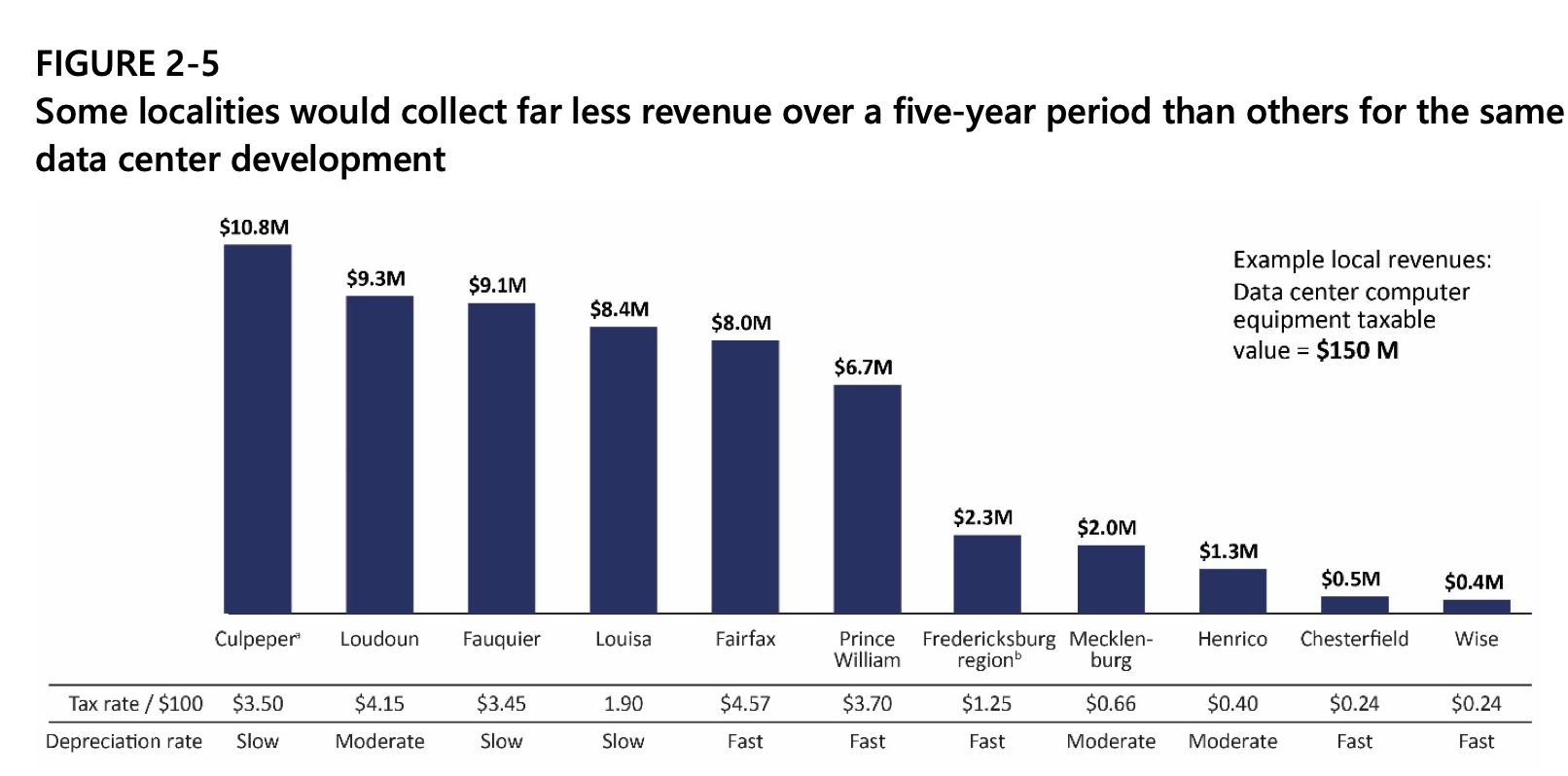
Culpeper collects $10.8 million. Loudoun, $9.3 million. Fauquier, $9.1 million. Louisa, $8.4 million. Fairfax, $8.0 million. Prince William, $6.7 million. The Fredericksburg region, $2.3 million. Mecklenburg, $2.0 million. Henrico, $1.3 million. Chesterfield: $500,000. Only Wise County, in far Southwest Virginia, collects less, at $400,000.
Chesterfield’s 24 cents per $100 rate, paired with a fast depreciation schedule, means the county collects roughly one eighteenth of what Loudoun gets from an identical building full of identical servers. JLARC’s own words, localities that slashed rates to attract the industry “collect far less revenue than other localities with a higher tax rate” would for a comparable project. Clover Hill Supervisor Jessica Schneider put it more bluntly to VPM News: “We are the lowest in the whole state.”
The discount that buys nothing
Here’s what makes the chart devastating rather than merely embarrassing. The counties at the expensive end of it are the ones drowning in data centers.
Fairfax charges $4.57. Prince William charges $3.70. Loudoun charges $4.15 and Loudoun is home to the largest concentration of data centers on the planet. JLARC found Loudoun pulled in roughly $733 million in data center attributable local revenue in a single fiscal year, and that data center money has let both Loudoun and Prince William lower their real estate tax rates on residents. Louisa County charges $1.90, eight times Chesterfield’s rate and still collects $8.4 million per facility in the JLARC model while hosting major data center development.
Data centers, per JLARC’s analysis, go where the transmission lines, fiber, and large flat parcels are. The tax rate is a rounding error next to the power bill. Northern Virginia proved you can charge full freight and the industry shows up anyway, because it has to.
Henrico ran the experiment. Twice.
If you want to know what the low rate strategy is worth, watch the county that pioneered it and then abandoned it.
In 2017, Henrico cut its data center equipment rate from $3.50 to 40 cents per $100, the lowest in Virginia at the time, an explicit play to attract the industry, per The Richmonder. It worked, helped enormously by the QTS Richmond Network Access Point, where three subsea cables come ashore. Henrico became a hub.
Then Henrico looked at its own math. In its FY2025-26 budget, per Richmond BizSense, the county proposed raising the data center rate from 40 cents to $2.60, a six and a half fold increase, projected to generate $13.6 million a year in new revenue. County Manager John Vithoulkas noted $2.60 would still sit below the state average of $3.09 and at least a dollar under the Northern Virginia localities Henrico competes with. The Board of Supervisors adopted it unanimously on April 8, 2025, per the county’s own release and used the money to help fund what officials called the county’s largest tax relief for residents since 1987. The data centers did not pack up their servers and leave. Development has continued.
Read that sequence again, cut the rate to attract the industry, land the industry, raise the rate 550%, keep the industry, hand residents a tax cut. It took one budget cycle to correct, because Henrico never signed anything promising not to.
Hanover is now walking the same road back. In June 2026, its supervisors moved to reinstate the county’s data center equipment tax, per Richmond BizSense, with a further increase to as much as $3 per $100 under study, per WTVR.
Chesterfield signed away the Henrico option
Which brings us to the reason this chart is a Chesterfield story and not just a Virginia curiosity.
Chesterfield cannot do what Henrico did. On June 25, 2025, its Board of Supervisors approved agreements with two LLCs behind the western data center projects, Skyward Holdings and Aeris Investments locking the 24-cent rate in place for 30 years.The mechanism matters. If a future board raises the countywide rate, the county pays the developers annual grants equal to the increase for the rest of the term. Chesterfield built itself a Henrico proof box. Any supervisor elected between now and the 2050s who looks at Figure 2-5 and reaches the same conclusion Henrico’s board reached can raise the rate and then mail the difference back to Google.
This is a documented pattern, not a hunch
The research on rate cutting as recruitment keeps reaching the same conclusion. JLARC’s November 2025 annual report on economic development incentives found Virginia’s state level data center sales tax exemption cost $2.7 billion from FY2015 through FY2024, 53 percent of all state incentive spending, hitting $1 billion in FY2024 alone, up from $685 million the year before, per Virginia Business. A JLARC associate director called it the “largest economic development incentive that the state is supporting.” A separate JLARC analysis, cited by VPM News, found the state recoups only 48 cents for every dollar it abates through the exemption.
Good Jobs First, a subsidy tracking watchdog whose figures lean critical of incentives, so treat its framing accordingly, has published a run of reports on the same dynamic nationally. 32 states exempt data center equipment from sales tax, ten of the twenty states that disclose costs lose over $100 million a year, and the states that computed returns lose between 52 and 70 cents per dollar spent. Its June 2026 update put Virginia’s combined state and local FY2025 loss at $1.94 billion. Its April 2026 Virginia report estimated roughly $267 million a year of that would otherwise flow to K-12 schools and found that of Virginia’s 133 counties and cities, only 36 disclosed any tax abatement programs at all, and exactly one mentioned data centers by name. That one, credit where due, was Chesterfield. The county disclosed the discount. It just also notarized it for three decades.
JLARC also found data centers impose minimal demands on local services, few kids in schools, little traffic. Chesterfield’s economic development staff project more than $4.2 million a year in county revenue per $1 billion invested, and what Figure 2-5 shows is what the bet cost and Henrico shows the bet didn’t need a 30 year term.
Eleven localities, one identical data center. Ten of them kept the right to change their minds. Chesterfield collects $500,000, second to last, and put it in writing until the 2050s.
There will be more articles expanding on all angles of this deal. Chesterfield is known for being a leader among localities. This deal cannot be explained by any members of the Board of Supervisors in any meaningful way. More to come on that.